How Is AI Used in Fashion? 12 Real Use Cases for Brands (2026)
12 min readAI now shows up at almost every step between a first sketch and a delivered order. This overview walks through 12 practical use cases across design, supply, content and selling, with the limits each one still has.
What you'll find in this article
- How is AI used in fashion?
- How is AI used in fashion design?
- How is AI used in fashion product and supply chain?
- How is AI used in fashion content and marketing?
- How is AI used in fashion e-commerce and customer experience?
- What are the limits and risks of AI in fashion?
- How should a fashion brand start using AI?
- Frequently asked questions
How is AI used in fashion? AI in fashion now supports every stage of a garment's life. Designers use it to sketch ideas and test colorways, planners use it to forecast demand, marketing teams use it to turn product photos into on-model images and videos, and online stores use it to personalize recommendations and let shoppers try clothes on virtually.
Key takeaways
- AI in fashion covers four stages: design, product and supply, content and marketing, and selling and customer experience.
- Content and marketing is where most brands start, because on-model images, product videos and photo edits are repetitive and easy to measure.
- AI clothing images show how a garment looks on a body, but they do not measure fit, so size guidance still comes from real measurements.
- Every AI output needs a review against the physical product before it goes live.
- Using real people in AI images or videos requires their rights and consent, and some platforms and markets require AI disclosure in ads.
How is AI used in fashion?
AI is used in fashion to speed up work that used to depend on manual sketching, guesswork, photoshoots and generic store pages. The table groups the 12 most common use cases by stage, from the first idea to the shopper's screen. Most fashion AI tools focus on one or two of these jobs rather than all twelve.
| Use case | What AI does | Who uses it |
|---|---|---|
| Design | ||
| 1. Design ideation | Turns text prompts and references into sketches and concept images | Designers, students |
| 2. Trend analysis | Finds recurring colors, shapes and details in images and search data | Designers, buyers |
| 3. Pattern, print and colorway variations | Generates new prints and recolors an existing design | Print and textile designers |
| Product and supply | ||
| 4. Demand forecasting | Predicts how much of each style and size will sell | Planners, merchandisers |
| 5. Digital sampling | Shows a design as realistic images before a physical sample exists | Product developers |
| 6. Quality checks | Flags defects and mismatches from photos of finished goods | Quality teams, factories |
| Content and marketing | ||
| 7. On-model images | Dresses a model in a garment photo with virtual try-on | E-commerce teams |
| 8. Product, lifestyle and campaign images | Generates new scenes from reference photos and a prompt | Marketers, social teams |
| 9. Product videos and UGC-style ads | Animates photos into short clips and ads | Performance marketers |
| 10. Photo editing at scale | Changes backgrounds, upscales and swaps models | Content and retouching teams |
| Selling and customer experience | ||
| 11. Personalization and visual search | Recommends products and finds items from a photo | Online stores |
| 12. Shopper-facing try-on and styling | Shows clothes on the shopper and suggests outfits and sizes | Online stores, shoppers |
How is AI used in fashion design?
In fashion design, AI works as a fast sketchbook: it turns words and references into images a designer can react to, edit and refine. The designer still decides what gets made.
1. Design ideation and sketches from prompts
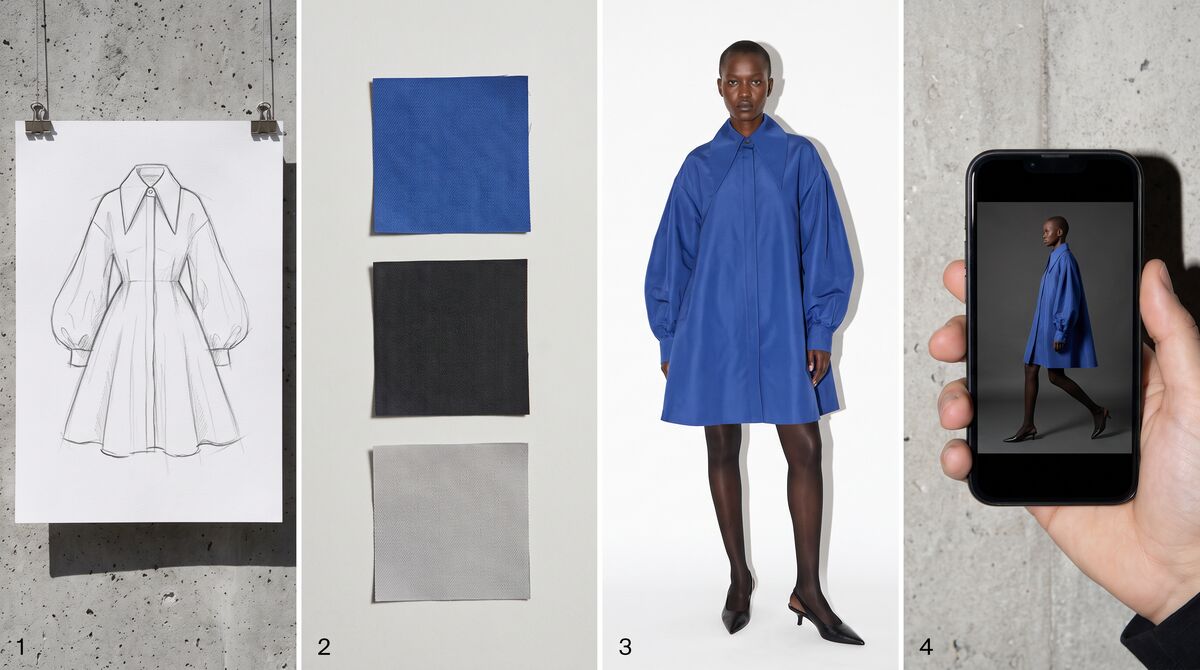
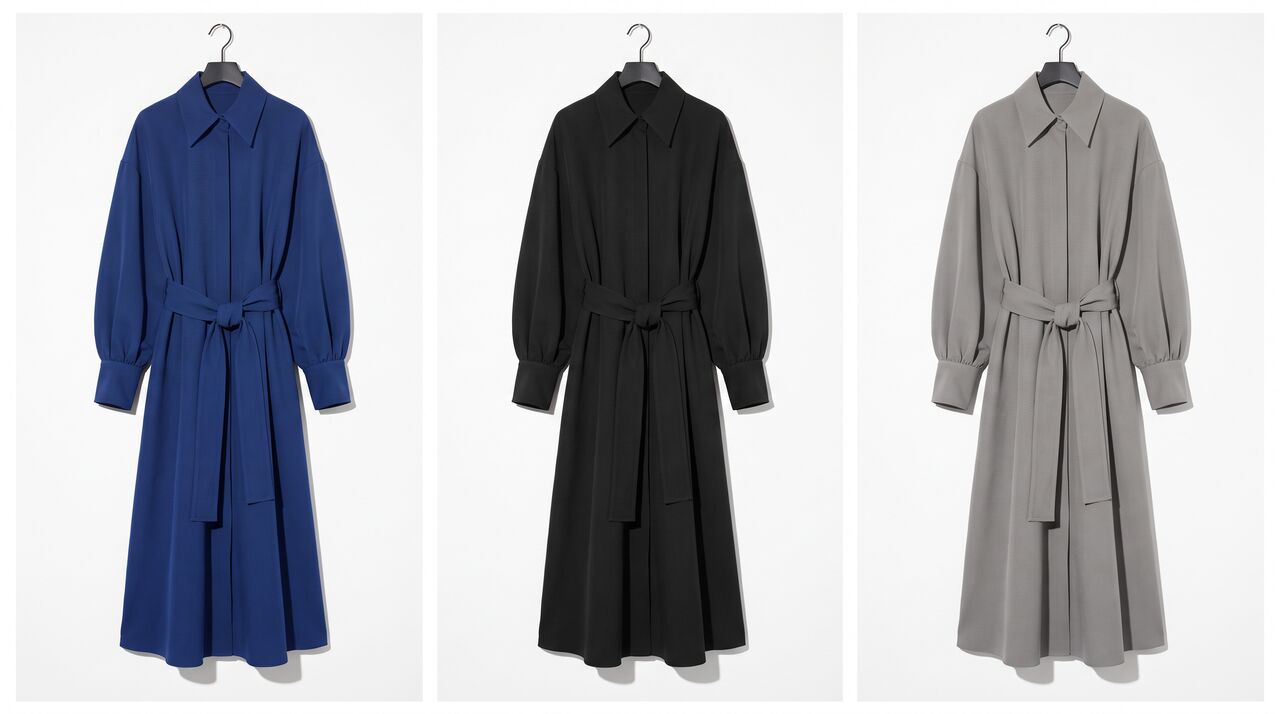
An AI clothing designer tool takes a prompt such as "an oversized shirt dress with balloon sleeves in heavy silk" and returns sketches or photo-like concepts in seconds. Image models learn the link between words and visual features, so a designer can explore many silhouettes before drawing one by hand. Designers, students and small labels use it for moodboards and early concepts. The limit: the output is an image, not a pattern, so the construction still has to be worked out by a person.
2. Trend analysis from images and search data
Trend tools scan large sets of images, such as runway photos, social posts and product listings, together with search data, and group what keeps appearing: a color, a sleeve shape, a fabric. Designers and buyers use these reports to support their instinct with evidence. The limit: trend analysis describes what is already visible, so it is weaker at spotting something genuinely new.
3. Pattern, print and colorway variations
AI can generate new prints from a description and recolor an existing design into several colorways while keeping the cut the same. Print and textile designers use it to show a buyer five options instead of one. The limit: a generated print is a picture; it still needs to be prepared as a repeat and checked on real fabric.
How is AI used in fashion product and supply chain?
In product development and the supply chain, AI is used to reduce waste: fewer samples, better quantities and earlier detection of problems. These uses depend on a brand's own data more than on creative input.
4. Demand forecasting and assortment planning
Forecasting models read past sales, seasons, prices and sometimes search interest, and estimate how many units of each style, color and size a brand will sell. Planners and merchandisers use the forecast to decide the assortment and order quantities. The limit: the forecast is only as good as the history behind it, and a brand-new category has little history to learn from.
5. Sampling with digital images before physical samples
Instead of sewing every idea, a product team can review a design as realistic images, and even as a short clip that shows how the fabric moves, before ordering a physical sample. Product developers use digital samples to drop weak ideas early and send fewer samples back and forth. The limit: an image shows the look, not the hand feel, weight or real drape of the fabric.
6. Quality and defect checks from images
Computer vision models compare photos of finished garments with a reference and flag likely issues: a stain, a misaligned seam, the wrong color or a missing button. Quality teams and factories use it to check more items in less time. The limit: models miss defects they were not trained to see, so a person still confirms each flag.
How is AI used in fashion content and marketing?
Content and marketing is the most common entry point for AI in fashion, because every product needs images and videos, and much of that work repeats from one product to the next. One good product photo can now feed a whole set of content.
7. On-model product images with virtual try-on
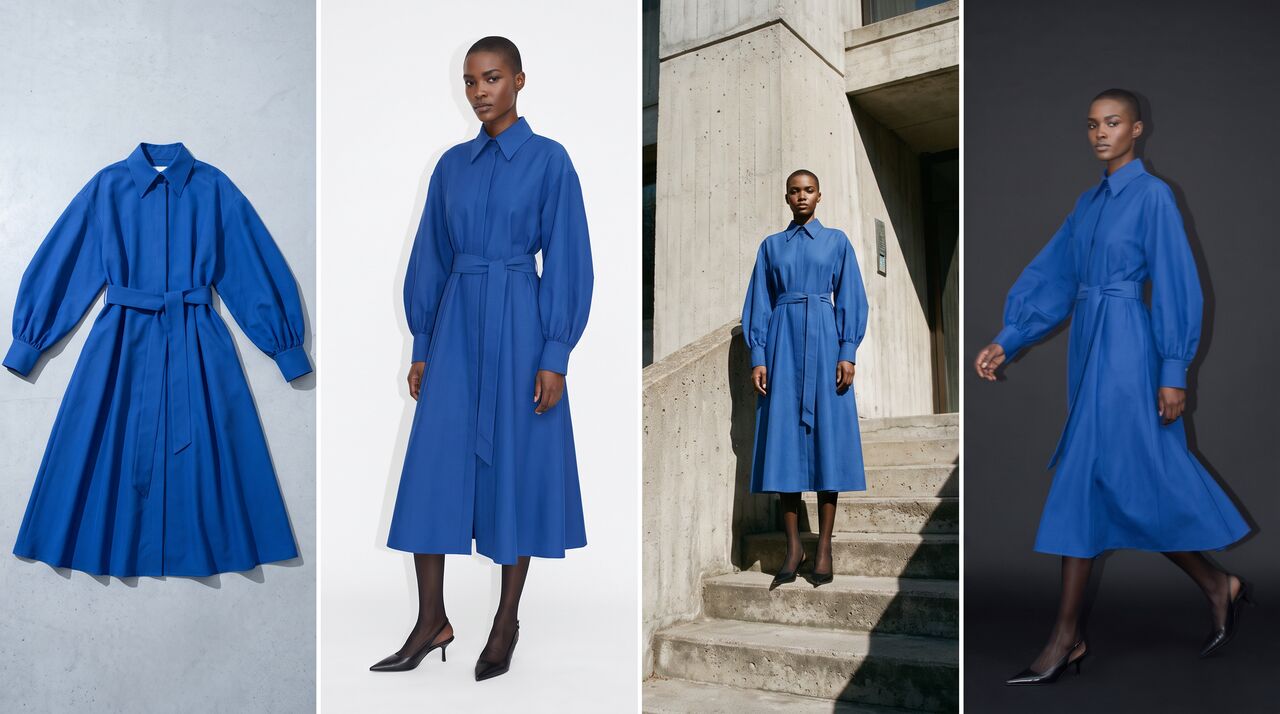
Virtual try-on dresses a model in a garment photo and keeps the model's face, body and pose. E-commerce teams use it to put every product on a model without a shoot. The guide on what AI virtual try-on is explains how the garment is kept accurate. Tools such as Fash Studio accept flat lays, ghost-mannequin shots and on-model photos as input, and offer built-in AI fashion model options with different looks, body types and ages. The limit: details such as print scale and button count still need a check.
8. Product, lifestyle and campaign images with AI image generation
An AI image generator for fashion takes reference photos and a prompt and creates new scenes: a clean product shot, a street lifestyle image or a campaign visual. Marketers and social teams use it to fill channels with fresh images without new shoots. The limit: the more the prompt changes, the more the product can drift.
9. Product videos and UGC-style ads from photos
An AI product video generator uses a photo as the first frame and animates it from a short motion prompt. An AI UGC try-on video generator goes further and turns a model photo and a product photo into a UGC-style ad, with built-in hooks and locations. Fash Studio's Advanced marketing videos take up to 7 reference images, a brief and an optional exact script. Performance marketers use these to test many ad angles. To see the full process, read how to turn a product photo into a video. The limit: fast motion can blur garment details.
10. Photo editing at scale
Editing apps handle single jobs across many images: an AI background changer places products in new settings, and an AI model swap replaces the person while clothing, pose and background stay. Fash Studio's apps also cover background removal, upscaling up to 4K, image extending, face swap, character swap, motion control on Kling V3 and media optimization. Content and retouching teams use them to adapt one shoot for many channels. The limit: edits of real people need their consent.
How is AI used in fashion e-commerce and customer experience?
In e-commerce, AI is used to help each shopper find the right product faster and feel more certain before buying. These tools sit on the store itself, facing the customer.
11. Personalization, recommendations and visual search
Recommendation models learn from browsing and purchase behavior and show each shopper the products they are most likely to want. Visual search lets a shopper upload a photo and find similar items in the catalog. Online stores use both to raise discovery across large catalogs. The limit: recommendations need enough data per shopper, and they use personal data, so privacy rules and clear consent apply.
12. Shopper-facing virtual try-on, AI stylists and sizing tools
Shopper-facing try-on shows clothes on the customer's own photo or an avatar. An AI fashion stylist suggests full outfits from a single item or a stated occasion, and sizing tools recommend a size from a few questions or past purchases. Online stores use them to answer "how will this look on me?" before checkout. The limit: try-on shows appearance, not fit, so a size recommendation should rest on real garment measurements.
What are the limits and risks of AI in fashion?
The main limits of AI in fashion are accuracy, fit, representation and rights. Each one can be managed, but none disappears on its own.
- Garment accuracy and returns: an image that changes the color, print or length of a product sets the wrong expectation and can lead to returns. Compare every image with the physical item.
- Fit is visual, not measured: AI shows how a garment could look on a body. It does not know the garment's real measurements or how the fabric stretches.
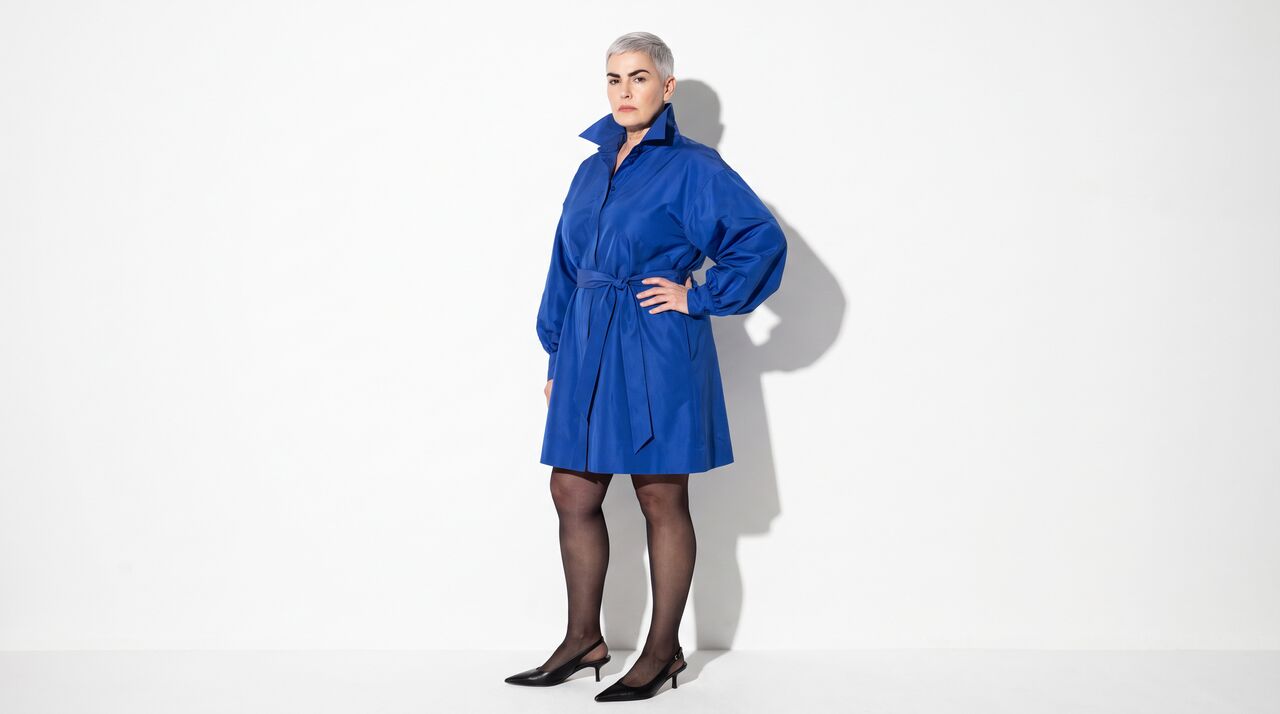
- Bias and representation: image models can repeat narrow beauty standards. Choose a deliberate range of ages, body types and skin tones, and cast and style every model with the same care.
- Rights and consent for real people: have the rights to every photo and the consent of every real person whose face or body appears in an AI image or video.
- Disclosure rules: some platforms and markets require a label when people or scenes in ads are AI-generated or AI-edited. Check the rules for each channel and country.
- Data privacy of unreleased products: uploading unreleased designs to a tool means trusting its storage. Read the provider's privacy terms and check whether uploads are used for training.
How should a fashion brand start using AI?
A fashion brand should start with one repetitive content job, prove the result on real products and only then scale. Five practical steps:
- Pick one repetitive content job. On-model images for new arrivals or background changes for a marketplace are good first choices, because the volume is high and the result is easy to judge.
- Start from true-color product photos. A sharp, evenly lit photo on a plain background gives the AI an accurate source for color and detail.
- Set a model and style guide. Fix the models, poses, backgrounds and framing you will use, so every product looks like part of one catalog.
- Review against the physical product. Check color, print, buttons, length and logos on every image before it goes live.
- Measure time and cost per image before scaling. Compare the numbers with your current production, as in this AI fashion photoshoot vs traditional photoshoot comparison.
When you are ready to choose a tool for the job, the list of 10 best AI fashion tools for e-commerce explains the main categories and what each one does well.
Start with the most common use case: turn a product photo into an on-model image with Fash Studio's AI virtual try-on.
Frequently asked questions
How is AI used in the fashion industry?
AI is used across the fashion industry for design ideation, trend analysis, print and colorway variations, demand forecasting, digital sampling and quality checks. In marketing, it creates on-model images, product and campaign images, product videos and photo edits at scale. In e-commerce, it powers recommendations, visual search, shopper-facing try-on, AI stylists and sizing tools.
Is there a ChatGPT for fashion?
There is no single ChatGPT for fashion, but general-purpose assistants are widely used by fashion brands for copy, ideas and prompts. For images and videos, brands add dedicated fashion AI tools for virtual try-on, backgrounds, model swaps and video. Many teams use both side by side.
Can AI design clothes?
AI can generate clothing designs as sketches and photo-like concepts from a text prompt or reference images, and it can create prints and colorway variations. It does not produce a finished sewing pattern or decide what fits a brand. A designer still selects, refines and engineers the design before it can be made.
How can I create an AI fashion model?
You can create an AI fashion model by describing the person you want, such as age, look, hair and build, in an AI image generator, or by choosing a built-in model in a virtual try-on tool. Save the result and reuse the same model photo for every product so your catalog stays consistent. If you base a model on a real person's photo, you need that person's consent.
Will AI replace fashion models and photographers?
AI is replacing much of the routine catalog and social content that used to need a shoot, such as on-model images for every product. Hero campaigns, real talent, fit content and creative direction still rely on people. Many brands now combine AI for volume with traditional shoots for key moments.
What is the easiest way for a small fashion brand to start with AI?
The easiest start is turning existing product photos into on-model images with virtual try-on, because it needs no shoot and the result is easy to check. Tools such as Fash Studio are credit-based, show the price before each run, keep uploads encrypted and never use them to train their own AI models, and allow commercial use of the results. Start with a few products, review them against the real items and then scale.
Create your first realistic fashion image in minutes.
Join thousands of brands turning product photos into model imagery, videos, and campaigns.
Get started →